

Positional Release for a Short Iliopsoas: Simple Thumb Test and a Two-Minute Reset
Positional Release for a Short Iliopsoas: Simple Thumb Test and a Two-Minute Reset
Overview
A quick screening and a short positional release can change how a tight or shortened iliopsoas behaves. The approach is simple, reproducible, and effective: use a thumb-length test to identify the side that needs work, then place the muscle in a shortened position from both ends and hold for about two minutes. That brief hold calms the muscle spindles, reduces the stretch reflex, and often produces immediate improvement before deeper work.
Here is a link to the YouTube video: https://www.youtube.com/watch?v=REzjiSGGRwU
How to Screen: the Thumb-Length Test
This is an accessible test you can use in clinic. Ask the client to bring both arms overhead and place the hands in a prayer position. Check that the heels of the hands sit on the same plane, then apply a gentle, not forceful, upward pull to give a light traction through the neck and torso.
Observe the thumbs. One thumb will often appear shorter. That apparent shortening commonly corresponds to a shortened iliopsoas on the same side. If the left thumb looks shorter, the left iliopsoas is likely the one to address first.
Modification for Shoulder Problems
If the client has limited shoulder range and cannot raise the arms overhead, have them cross their arms in front of the chest. Proceed with the same checks, making sure the heels of the hands are level. Raising the arms is useful because it adds a little traction, but crossing the arms still provides a valid screening position.
Why a Short Thumb Can Indicate a Short Iliopsoas
The connection has to do with the attachments and chain reactions through the torso. The iliopsoas has attachment relationships that influence the thoracolumbar area around T12. When that region is restricted or the muscle is shortened, it can pull the torso slightly downward and create a contralateral rotation. This subtle rotation is what makes one thumb appear shorter in the overhead test.
"You always want to work the short side first."
Positional Release Technique for a Short Iliopsoas
The goal is to place the iliopsoas in a shortened state from both ends and hold long enough to calm high spindle activity. A locked short muscle has a high spindle bias. By shortening the muscle and holding, you reduce spindle signaling and the stretch reflex becomes less active. The compressive force awakens "recognition" between the two bones (femur and the acetabulum of the ilium) through stimulating the proprioceptive nerves in the joint and surrounding fascia.
Step-by-step
1. Identify the short side using the thumb test. Start treatment on that side, but plan to address both sides eventually.
2. Shorten the upper end: side bend the upper body from the thoracic spine toward the same side. Use a gentle, small side bend to take slack into the thoracic attachment.
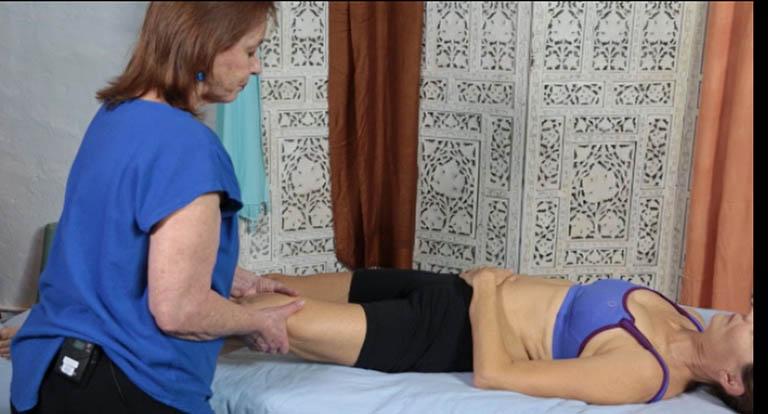
3. Shorten the lower end: slightly flex, abduct, and externally rotate the thigh. Place your hands on the femur and compress the femur gently toward the acetabulum. This is compression, not deep soft tissue work on the quadriceps.
4. Hold the position for approximately two minutes. Keep the contact gentle and steady. The muscle spindles quiet down during this time.
5. After the hold, retest the thumbnail length or repeat the original screening. You will often see noticeable improvement after a single two-minute hold.
Clinical Tips and Cautions
• Always start with the short side, then treat the other side as needed.
• This is a positional technique. Avoid aggressive compression or deep tissue release during the hold. The effect comes from the shortened positioning, not brute force.
• Retest after the positional release before proceeding to deeper soft tissue work. This technique can make subsequent releases safer and more effective.
• Use caution with acute hip pathology, recent surgeries, or implants. Modify or avoid compression into the acetabulum when contraindicated.
Why This Works
Locked short muscles tend to have increased muscle spindle activity, which drives a strong stretch reflex and maintains tone. Positioning the muscle in a shortened state reduces spindle firing. Holding that position for about two minutes allows the nervous system to recalibrate and reduces the muscle's defensive tone. The result is often an immediate reduction in perceived shortness and improved symmetry on retest.
Quick Protocol Summary
• Screen with the thumb-length test, arms overhead or crossed.
• Work the short side first.
• Shorten the muscle from both ends: thoracic side bend and hip flex/abduct/externally rotate with gentle femoral compression.
• Hold for two minutes.
• Retest and proceed to deeper work only if necessary.
A brief positional release can be a powerful, time-efficient tool. Use it as a preparatory step before deeper manual therapy on the iliopsoas, and you will often find treatment becomes easier and more effective.
If this post resonates with you, you'll love my master class:
In this one-hour training, you'll discover how anatomy, the nervous system, and pain science work together to influence movement, protection, and healing. You'll gain a deeper understanding of the iliopsoas and quadratus lumborum—and learn why understanding the body is about much more than muscles alone.
**See deeper. Think clearer. Treat better.**

0 comments
Leave a comment