

Course Content







Gua Sha Functions, Uses, Actions
Gua Sha Functions, Uses, and Actions
Eastern Medical Theory
We often translate the word ‘Qi’ from Chinese into the English language by describing it as energy. This does not even come close to the full embodiment of Qi. If we were to consider Qi as ‘vital energy’ it would be much closer, as Qi incorporates not only the substance ‘energy’ but also the action that is required in body function. The idea of vital energy’ implies that there is some kind of dynamic action that is at play, which is exactly what the concept of Qi should be understood as. The Yin aspect of Qi would be its substance, as in the body, and the Yang aspect of Qi would be its action because as we know, Qi is active in nature.
Recent research has made the connection of Qi with the ATP that is produced in the cell mitochondrium.
In Chinese Medicine, we consider the skin and body hair to be the Biao, or the surface of the body. These areas have no blood supply or nerve endings and are made of mostly collagen.
Under that is the Cou Li, or the lining which translates as the pores and its function is to allow entry and exit. The skin is the largest organ of entry and exit in the body, and this system lies just under the skin.
This is where the channels, and the ‘three steam’ lie (three burners/San Jiao) and in more contemporary thought is considered to be the connective tissue, or myofascial system. The connective tissue surrounds and anchors all of the structures in the body, including but not exclusive to the bone, venous system, muscle, and organs. There are many layers of connective tissue down to a cellular level, and it is what sustains our form. Contemporary medicine has now identified the connective tissue as its own organ system, and we would most closely attribute it to the San Jiao in TCM.
Fascia
For this discussion we will focus on the fascia, which is the connective tissue that binds and supports in compartments that that aid in supporting the skeleton, muscles and organs to maintain their structural integrity. Connective tissue is filled with a clear viscous fluid called ground substance. The viscosity varies depending on that tissues it is supporting, but it is the conductor of all intercellular fluids. Nutrients, hormones, and plasma are all carried from blood vessels to cells through ground substance, and cellular waste is carried from cells to blood and lymph vessels. When the viscosity of ground substance is affected by stress, trauma, dehydration, or disuse, the circulation and passage of ground substance is compromised. Collagen fibers and fibroblast cells are also contained within ground substance.
FUN FACTS
- Collagen comprises up to 40% of all the protein in the body. The collagen molecule that makes up a collagen fibril is the longest molecule ever isolated, is hollow, and require 10,000 times their own weight to be stretched
- Fibroblasts produce other ground substance and collagen, and may migrate anywhere in the body
- A more fluid ground substance with fewer fibrils conducts more easily and provides a metabolic function
- Connective tissue that holds organ and nerve cells contain more fiber and less fluid
- The compartments of connective tissue influences the spread of toxins, infections, disease and tumors, implicating connective tissue in immunity
- The fibrous walls as well as chemicals in the ground substance prevent the spread of agents from one site to a nearby one
- If the integrity of the connective tissue is compromised, its immune function declines
(Juhan 1987)
The layers of connective tissue each have slightly different purposes, and their properties also vary. The superficial fascia is where the main fatty tissue or adipose tissue acts as an insulating layer on the exterior of the body and the organs. This is where the Wei Qi is said to circulate through the body.
The deep layer of the superficial fascia contains that arteries, veins, nerves, and lymph. The deep level of fascia holds the muscles, large blood vessels, large nerves, deep lymphatics, and certain glands. Another category of connective tissue is the unspecialized connective tissue. It is associated with all other body systems, and seems to correspond with the ‘Cou Li’, which is the indicated location of the meridians, and regulated by the San Jiao. It has been suggested that the loose connective tissue function as the transmitter of mechanical signals to and from the immune, vascular, and neural cells in the body. (Latridis et al 2003)
Connective tissue plays an important role in the distribution of fluids and in the bodys’ water metabolism. So, we can see the similarity in function to the San Jiao, which is said to distribute water.
Action of Gua Sha
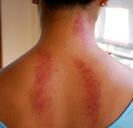
When applying Gua Sha, one will notice a gradual reddening of the tissues. This is known as petechiae. Sometimes the colour will appear darker, in a brown, gray, blue or black tone.
After treatment he patient usually feels invigorated or energized. Acute pain usually changes immediately, and is sometimes completely resolved.
The application of multidirectional force and stretch are thought to cause restoration in the connective tissue and its innervations, but only to certain kinds of connective tissue. Results vary based on intention, pressure, duration of application, repetition, other therapeutic interventions etc…
3 main characteristics of Gua Sha:
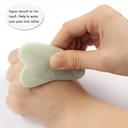
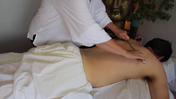
1) Closely repeated uni-directional stroking that intentionally presses into the fascia
2) Application is predominantly along a muscle and specifically not oscillating or across muscle tissue
3) The intentional creation of transitional petechaie and ecchymosis
(Nelson, 2013)
The San Jiao, and its role in Gua Sha
The San Jiao system has been the most challenging and difficult system to comprehend in the Meridian and Channel System of Traditional Chinese Medicine throughout its history. Our current understanding of the San Jiao and the system of the connective tissues is probably the most clear similarity that this system has experienced. The relationship of the San Jiao system and its function of connecting all parts of the body and
systems has always been a challenge to explain and understand. The concept of the three burners; uppermiddle and lower and their function is just one way of understanding. 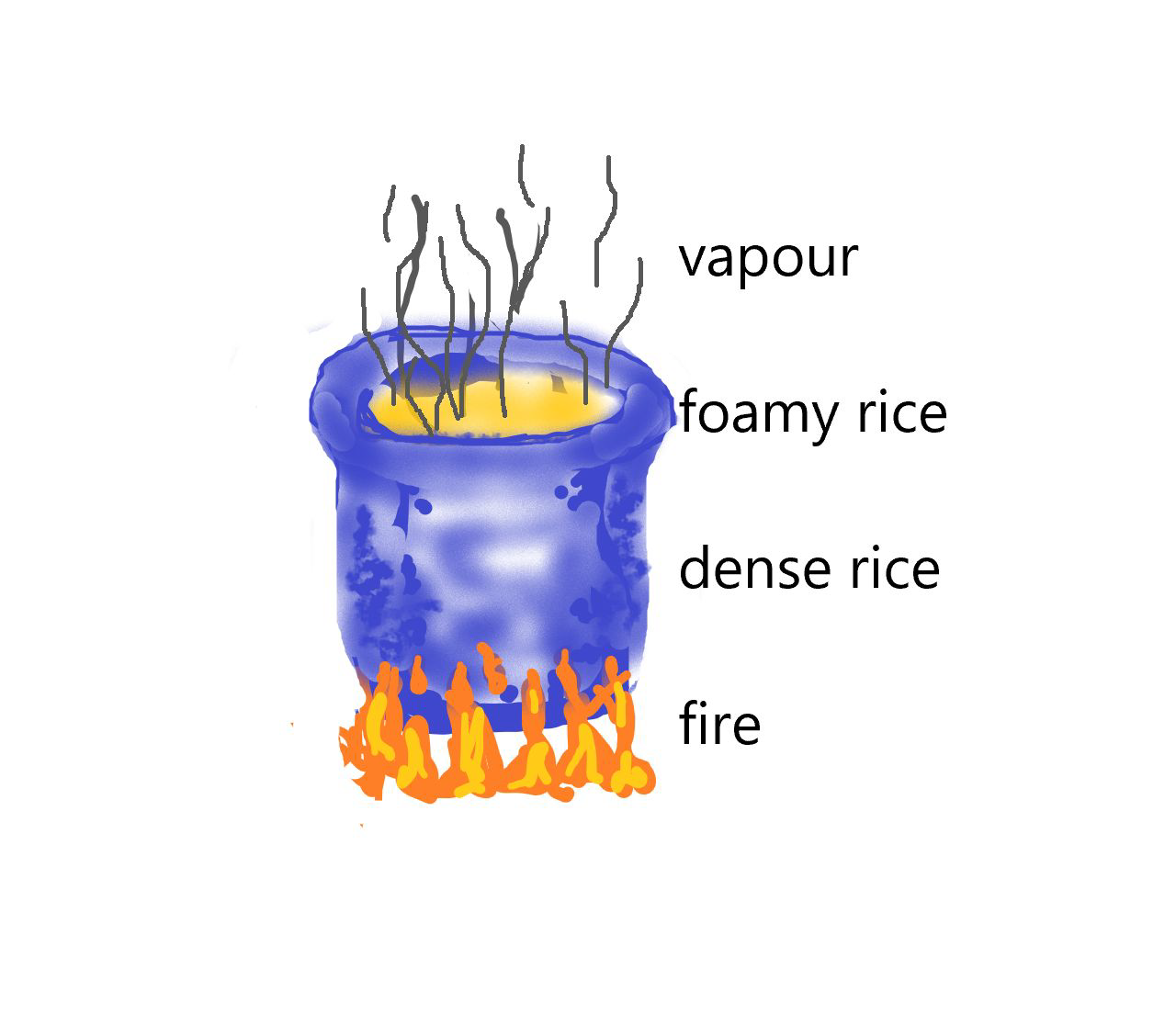 The San Jiao is seen as the medium through which the process of transformation occurs within the body seems to be connected with the theory of the fluid of the ground substance in the connective tissues.
Historically, it has been said that the San Jiao is an organ without form, and we can now challenge this concept with our more recent understanding of the system of connective tissue in the body.The San Jiao protects, but also conducts pathogenic factors such as Wind, Cold, Damp, Heat, and Dryness.
Wei Qi
The Wei Qi cannot enter the channels, but resides at the level of Cou Li. Its function is to warm up the muscles, fill up the skin, open and close the pores to protect the body from penetration of Cold and Wind. Wei can be translated as body fat, the adipose tissue of the superficial fascia. As an exogenous pathogen enters the body, it penetrates the Cou Li and can penetrate the system of connective tissue that are between the surface and the internal organs.
The Shao Yang and Gua Sha
The Shao Yang system includes the sides of the body, and is related to the San Jiao and Gallbladder meridians. It is said to be half interior, and half exterior or half Biao, half Li. So it can be said that the Shao Yang is the pivot channel from ‘outside to in’. The Shao Yang exhibits a mixture of symptoms both exterior and interior such as alternating fever and chills, aches and pains, no appetite, and sweating does not resolve fever. There is often a lack of urination (dysuria) or lack of sweating. In a Shao Yang situation, the fever is not usually high, but more if a low grade fever situation. If the fever rises, it indicates that the pathogen has progressed more deeply inside, and may have reached the Yang Ming Fire. When the Shao Yang stage is not resolved, it can become a chronic feeling of un-wellness, such as the condition of chronic fatigue. This is the kind of pathogenic illness that we call half-sick.
0 comments
Leave a comment