

Course Content




History of Gua Sha
History
The theory of scraping stems back to the early times of ancient medicine, where we can witness the creation of such texts as the Yellow Emperor's Classic in China, and the Ebers Papyrus in Egypt. It only makes sense that this information exchange occurred during the exchange of goods, including medicine along the long course of the Silk Road.
Hippocratic medicine held the belief that sickness was the result of impurities in one of the "four humors". Apotherapy was the restorative treatment used which goal was to remove or dimish the offending humor by "purging, bleeding, vomiting, urinating, salivating or sweating" (Nielson, p3)
Anatriptology was the scientific use of friction for remedial use. Frictio literally means to move along a surface with pressure - to rub, grate, chafe, stress, or irritate. Hippocrates specified four types of friction as counteractive therapy.
All friction creates heat, as well as loosening, binding, augmenting, and diminishing.
Four types of friction were identified by Hippocrates, and Galen continued in the work to identify six kinds of friction. The Chinese believed that the type of friction to be used was determined by the time of year as well as the condition of the patient (Kaim, 1756)
It was accepted at the time that the conditions which appeared in the body had a tendency to be quite extreme, and that two pathogens could not exist in the body at one time. This in itself displays the shift that has occurred in the human condition, as we see now in clinical practice our patients arriving
with multiple complaints, and a slew of medications to treat them. Hippocrates believed that the ‘cause of disease should be sought in nature, the cure due to nature.’
Chinese Medicine Doctors also saw humans as a microcosm of nature, and that we were one with the cosmos. Humans were but a small portion of the bigger picture.
This theory of strengthening resistance was popular until the last century, when the idea of counteraction became popular. This again was developed under the premise that only one disease could exist in the body at a time, therefore by introducing a new pathogen, the body would be forced to face an artificial crisis, and this would accelerate healing.
This initiated the practice of deliberately applying a counteractive technique to activate the bodys healing response. In early Western medicine, infections were being treated by applying surface agents to induce inflammation and rashes. A common counteractive practice in the west was to apply a seton to the back of the neck.
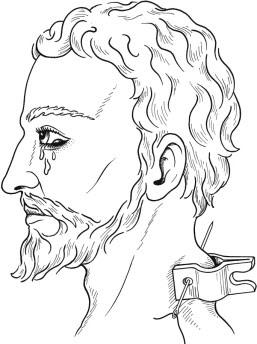 This is where the skin is pinched and a fiber or hair was threaded into the flesh. The intent was that the surface infection would cause a mild infection that would counteract a deeper infection. In this image, the patient has a chronic running eye sore. Galen believed that the reason that counteractive techniques worked was that the secondary irritation drew blood away from the original injury site, thus reducing inflammation.
In 1841, Granville discusses counteraction as the direction of fluids in the following statement:
Where a force has been used to direct fluids to a particular region of the body, with a view to relieve another region of the body labouring under disease. We have affected that object by merely changing the location of those fluids. Expulsion of fluids at the surface of the body, as in perspiration associated with a fever was a natural counteraction. Sweating acts as a counteractive method to draw fluids to the surface of the body.
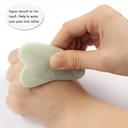
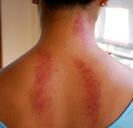
It can be said that Gua sha is a counteractive method used to induce an artificial crisis, resolving the inner disease by countering the internal inflammation.
0 comments
Leave a comment